
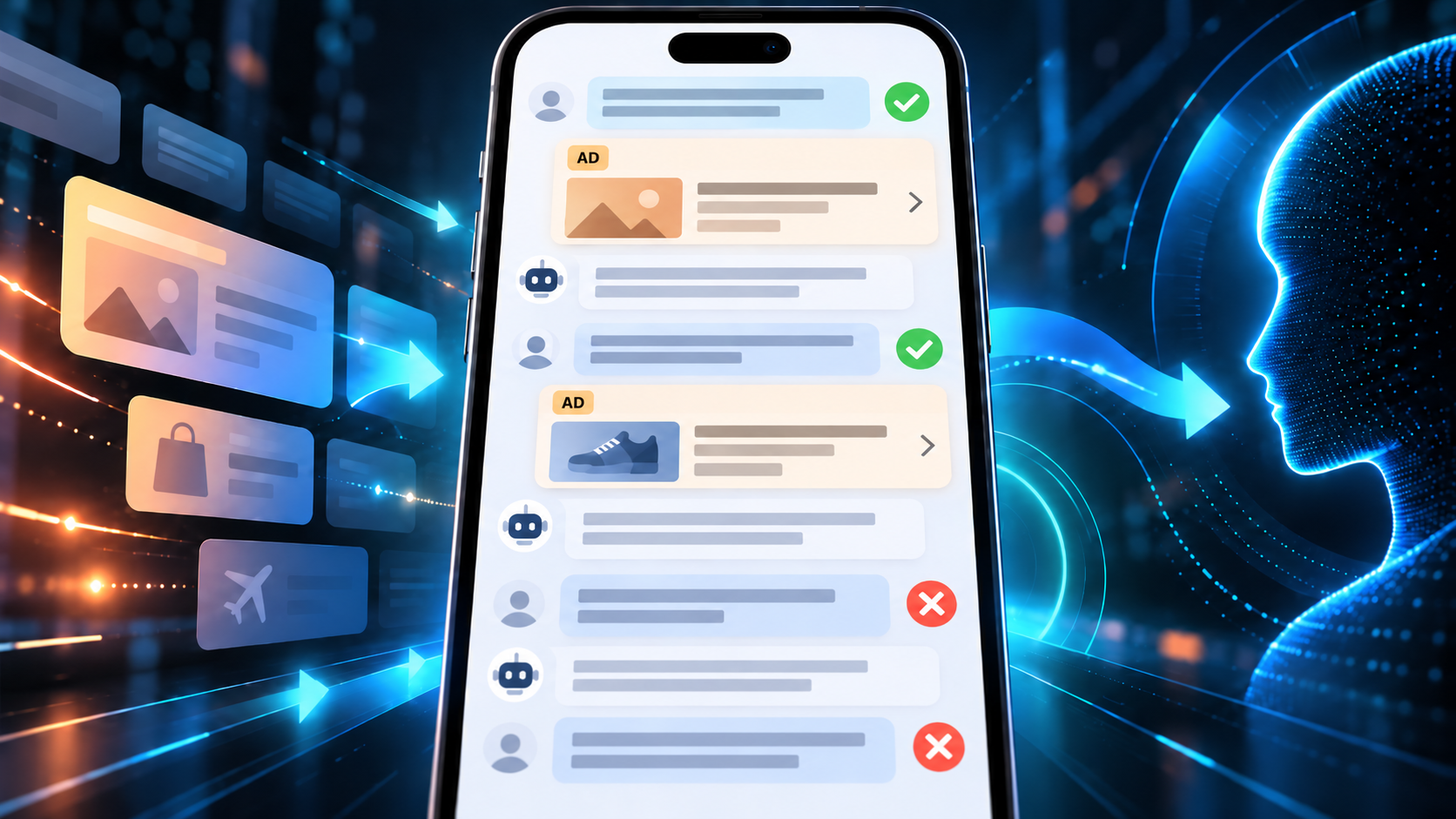
What Does “Near” Mean in a Conversation?
By AJ Brown and Dave Byrne • October 19, 2026
Brand Safety in the Conversation, Part 2
In Part 1, we explained why advertising inside an AI assistant is unlike anything advertisers have bought before. The answer above the ad is generated moments before the ad appears, the conversation around it is private to one person, and the platform selling the ad is the only commercial party with access to it. That’s why the four buyers Adweek reported on in September asked OpenAI to show them the prompts behind their ads, and why OpenAI can’t easily give them that in the form they asked for.
In this part, we’ll examine a more foundational problem underneath those requests. Every brand safety promise comes down to keeping an ad away from certain content. In a chat, nobody has publicly agreed on what “away from” means. How far away? For how long? Measured against what? Without a common understanding of ad adjacency in AI chatbot environments, brand safety policies can’t be operationalized or checked.
If you buy, sell or verify ads in chat, this matters to you. The answer decides what a policy really covers, what a pilot can measure, and what a platform can honestly promise a careful buyer. We’ll look at what “near” would have to mean in a conversation, and we’ll introduce a term, answer adjacency, that we think the industry needs.
How far is “away”?
OpenAI says its ads stay away from mental and personal health, emotional reliance and what it calls sensitive user journeys. That’s a fair place to start, but it doesn’t say how far “away” is. The same policy says ads are placed “near chats” that meet its standards and talks about “ad adjacency,” but we couldn’t find a definition of either one. An ad could stay clear of a chatbot answer that isn’t compatible with an ad, it could steer away from the current “turn” (one exchange, made up of the user’s message and the assistant’s reply), the last five turns, or everything said in the conversation so far.
OpenAI says its ads stay away from sensitive topics, and its policy says they sit near chats that meet its standards. That is the same distance question described from two sides. A conversation can count as near or away depending on how much of it gets checked, and the policy doesn’t say how much.
The rest of the industry has done some of this work already. Past industry efforts have established a common understanding of adjacency for feeds, stories, and in-stream ads as a distance in space or time (for example, see ISBA’s Responsible Media Guide). That works because those formats don’t change. A post stays where it was published. A video has a set running order.
But the industry currently doesn't have a body that has taken up the mantle of working collaboratively to define adjacency as new ad environments evolve. This isn't only true for AI chatbots; there's no explicitly agreed upon industry standard for ad adjacency on the open web, non-pre-roll video ad formats, mobile app ads, podcast ads, among others — just the business practices of various verification vendors.
Chat could borrow from established industry norms by counting a fixed number of answers or turns in lieu of pieces of content in a feed. It would feel precise, but it would miss cases where something said earlier still changes what the conversation means. A window that grows with the topic might be safer. Then the buyer has to trust the platform to decide when to widen it and when to shrink it again. Next, we’ll attempt to distill the various considerations for adjacency in chat into clear categories:
The six types of adjacency
By our assessment, there are six types of adjacency a chat policy could potentially cover. We lay out each type below, along with what to ask a question to assess whether each type is addressed:
|
Adjacency Type |
What it covers |
What to ask a platform |
|
Answer |
The assistant’s reply, checked separately from the user’s prompt. A harmless prompt can lead somewhere sensitive, and a sensitive prompt can get an answer with none of the original wording. This is the closest analogue to the existing industry concept of “direct” ad adjacency. |
Is the reply assessed on its own, not just the prompt? |
|
Turn |
One exchange: the user’s message, the assistant’s reply and the ad below them. Easiest to check, but it can miss an earlier disclosure. |
Does the platform evaluate anything beyond the current turn when deciding whether an ad should serve? |
|
Session |
The whole conversation so far, since earlier turns often explain the current one. |
How many turns back does the platform look, and if a previous turn in the session was deemed unsafe/unsuitable for ads, how many subsequent “safe” turns does it take until an ad can serve again? |
|
Memory |
What the assistant remembers from past chats. |
If memory can help pick an ad, can it also block one? Which wins when memory indicates that an ad both should and shouldn’t serve? |
|
Recommendation |
The assistant is already comparing products or suggesting a provider when a sponsored result appears, so the ad can borrow its authority and appear as the platform’s recommendation. |
Is there research/evidence to substantiate whether users understand the separation between chatbot advice and the ads that accompany its responses? |
|
Action |
The user is asking the chat to help finish something, such as booking a flight or buying a product. An ad shown at that point sits right next to the decision, not during research, so it can look like part of the answer. |
Do users see sponsored options mid-task? If a mid-task ad changes what the AI recommends, is that recorded and disclosed to the user? |
Answer adjacency
We use answer adjacency to mean the relationship between the answer the assistant writes and the ad shown with it.
It needs its own name because almost everywhere else, the content next to an ad already existed before the ad went there. A publisher wrote the article. A creator uploaded the video. Even a search result points to something that was already there. In chat, the company selling the ad dynamically generates the answer above the ad, in response to the user, at the same time the ad is served.
OpenAI says ads don’t influence ChatGPT’s answers and are kept separate and clearly labeled, but as we discussed in Part 1, a user can still read the answer and the ad as one response. Say the assistant recommends a type of product and a sponsored option appears underneath. The label tells the user who paid, but it doesn’t say whether the assistant seems to back it.
The same ad can mean different things depending on the answer. Under a recommendation, it can look like the preferred choice. Under a warning, it can look careless. Today’s adjacency standards say little about this, because back when the industry aligned on those standards, platforms weren’t generating custom content for one person at the moment they sold the ad space next to it.
Turn adjacency
As discussed above, turn adjacency is similar to answer adjacency, except that it treats the user’s prompt and the associated AI response as a combined “unit” of adjacency, rather than just the AI answer that accompanies the ad.
Session adjacency
OpenAI says that in longer conversations it looks at the overall context and user experience. That leaves three questions open: how far back the platform looks, how long a sensitive flag lasts once the conversation moves on, and what happens to an ad that has already served when something sensitive comes up later.
The lookback matters because relevance cuts both ways. In DoubleVerify’s 2026 survey of 22,000 consumers, ads in an AI chat only got more positive reactions than negative ones when they were highly relevant to the conversation. In the North American edition, a highly relevant ad got 31% positive and 19% negative reactions. In a negative or sad chat, that flipped to 20% positive and 34% negative. In a highly personal chat, it was 22% and 32%. What makes an ad work is the same thing that pulls it toward the personal parts of a conversation. (The survey used hypothetical scenarios, so these figures reflect expectations, not reactions to live ads.)
Flag duration is a trade-off with no obvious right answer. Someone might open with something sensitive, then spend twenty messages on an ordinary household purchase. If ads stay off for the whole thread, that moment is protected, but the platform gives up inventory. If the flag expires, ads may return minutes after the disclosure. Platforms will have to pick a duration and say what resets it.
The hardest case runs in reverse. A user asks for help choosing an affordable meal-delivery service, and an ad appears below the answer. A few messages later, they mention a health condition that would have ruled out food or weight-related ads if they’d said it first. The ad followed the rules when it served, but it’s still there when the user scrolls back, sitting just above what they disclosed. We couldn’t find anything saying whether a later flag can affect an ad already in the thread.
Memory adjacency
When ad personalization is on, ChatGPT may use past chats and memory to pick ads. Memory is the feature that makes the assistant useful, and it’s also what makes using it for ads feel invasive. A remembered interest in a travel destination could help pick a hotel ad. A remembered health issue could make an otherwise relevant ad a bad fit.
A platform that uses memory only to keep ads out of sensitive chats is still using it. One that ignores it gives up its best safety signal.
Recommendation adjacency
Recommendation adjacency covers the case where the assistant is already doing the advertiser’s job in a way: comparing options, weighing trade-offs or naming a provider. This happens behind the scenes when deciding which ad(s) to serve alongside a specific response. A sponsored result that shows up in that moment borrows the assistant’s authority. It can look like the assistant’s final pick even when it’s labeled as sponsored. Buyers should ask whether anything stops an ad from showing up under advice that contradicts it, and this area would benefit from user research to substantiate whether users truly view the ads alongside chatbot responses as being separate and distinct from the response itself, and whether they interpret the ad as a recommendation from the platform even if it’s appropriately labeled.
Action adjacency
Assistants are starting to book, buy and fill out forms for people. This creates a kind of adjacency no earlier format had, where an ad stands to influence the agent acting on the user’s behalf rather than the user themself. A sponsored option shown mid-agent-task raises questions the industry hasn’t had to answer before: if an agent picks a sponsored option, was that the user’s choice or the assistant’s? Was the user ever shown the ad, or did it only reach the agent? Would the outcome have been different without the ad? Will users trust agents to act on their behalfs if those agents can be influenced by paid advertising? Without records of how sponsored options affect what the assistant actually does, nobody can check a platform’s claim that ads don’t influence answers once those answers turn into actions.
Additional Adjacency Considerations
Ad-to-Ad Adjacency
OpenAI says users may see one or more ad units below a response, from one advertiser or several. Over a long conversation, those placements add up. The user sees the whole sequence, even though the ad system judges each ad on its own.
The obvious worry is two competitors showing up in neighboring turns — a longstanding concept that carries over from linear TV ad breaks and, more recently, ad pods in CTV/streaming. The concept has also recently extended to surfaces like Instagram Reels as ads are placed next to ads in social environments. A quieter problem is pressure that builds up in a linear conversation in chat. An airline ad, then a hotel ad, then a credit-card offer can make the conversation feel like a sales funnel, even though each ad passed its own check.
Frequency caps count how often someone sees an ad. They don’t tell a buyer which other brands showed up nearby or what the sequence looked like. Chat will need a way to keep ads apart across a whole session, on top of normal frequency controls, and to ensure that brand safety mechanisms and suitability controls apply to the content and ad(s) adjacent to the ad in question.
When the ad starts a conversation of its own
OpenAI already lets a user message an advertiser through an ad. The advertiser only sees the messages sent directly to it, which keeps the two conversations private from each other.
The safety side is less clear. We couldn’t find anything saying whether a sensitive flag from the main chat carries over into the conversation with the advertiser, or who monitors that conversation. It’s also unclear whether anything said to the advertiser changes which ads show up when the user returns to the original chat.
Ads that travel
OpenAI has said ChatGPT removes ads from exported conversation logs. Shared links are less clear. OpenAI describes them as a snapshot of the conversation up to the moment it was shared, and we couldn’t find documentation on whether ads appear in them. If an ad can persist in a shared link or a screenshot, it reaches an audience nobody considered when it was delivered.
Measurement needs the same unit as the policy
OpenAI’s recently announced DoubleVerify and IAS pilots should say which of these six adjacency types (and additional considerations) they test, along with any other dimensions we’ve missed here. A good result at the turn level says nothing about something disclosed earlier in the chat. A session-level test could still miss the use of memory, or the effect of several ads in a row.
Today’s existing industry standards cover established feed and in-stream formats. A version for conversations should say what the platform checks around each ad, and how long a sensitive flag lasts. It should also cover ad sequences and the separate conversation an interactive ad creates.
If every platform and verification company picks its own definition of near, their results can’t be compared. Buyers will get several versions of the same promise, each based on a different slice of the conversation. Part 5 covers this in more detail, including the difference between testing a platform’s safeguards and checking where live ads actually ran.
What marketers should ask
- Put the adjacency window in the pilot brief. “Conversation-level” is too vague unless the platform says which turns, answers and memory signals it counts.
- Ask whether an ad stays visible when the user scrolls back or travels with a shared link, and whether a later disclosure can change its status.
- Ask for reporting by session as well as by impression. A session view can show competitor collisions, or a run of ads that no single impression record captures.
- Treat a chat with an advertiser as its own surface. Write down its moderation rules and how it connects to the main conversation before you buy interactive formats.
Platforms can keep raw transcripts private and still publish the rules they use to decide which parts of a conversation count. Verifiers can then test those rules, and buyers don’t have to take the word “near” on faith.
Part 3 looks at the content categories that apply inside that boundary, and where the categories advertisers already use are insufficient for the risks that show up in chat.
Nobody owns this definition yet, and we don’t think the two of us should write it alone. These are the questions we’d most like to hear answers to:
- How many turns back should a platform look before it places an ad?
- How long should a sensitive topic keep ads off a conversation?
- Which of the six types of adjacency should every platform have to state in its policy?
If you work on the platform, buying, verification or policy side, reach out to us and tell us where you land, including if you think we’ve got it wrong. We’ll bring the best of what we hear into the rest of the series.
Topics: Ad Adjacency, 2026, artificial intelligence
Want To Stay Ahead In Brand Safety?
Sign up for the BSI Newsletter to get our latest blogs and insights delivered straight to your inbox once a month—so you never miss an update. And if you’re ready to deepen your expertise, check out our education programs and certifications to lead with confidence in today’s evolving digital landscape.